Smoke, Heritage, and Stars: How Regional American Charcoal Traditions Are Finding Their Place in Fine Dining
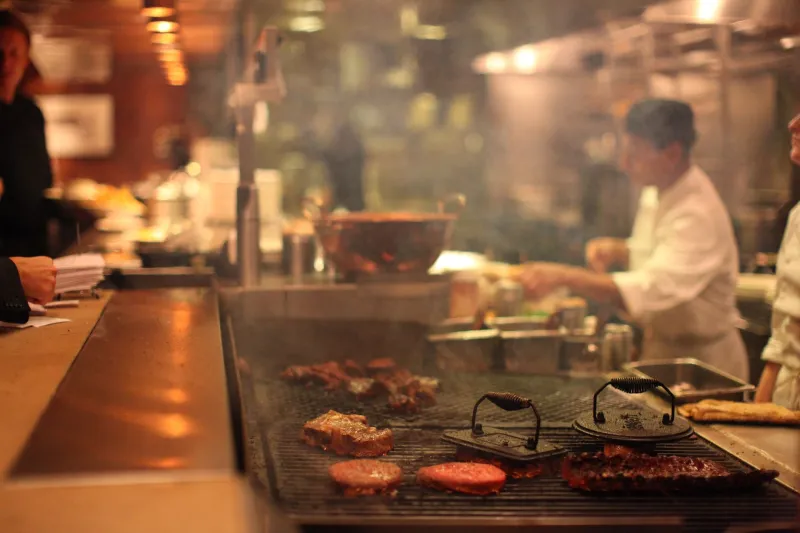
For much of the twentieth century, American fine dining looked to Europe for its grammar. French technique, Italian sensibility, and the conventions of Continental service defined what it meant to eat expensively and well in this country. Charcoal cookery—with its associations of backyard informality, regional identity, and working-class tradition—occupied a different world entirely.
That division has not simply narrowed. In a growing number of American cities, it has collapsed.
A cohort of serious, technically accomplished chefs has spent the past decade building restaurant programs that take the smoke and char of regional American barbecue not as a starting point for nostalgia, but as a foundation for genuinely ambitious cuisine. Their work raises a question that would have seemed almost absurd a generation ago: what happens when the pit meets the tasting menu?
The Lowcountry as Blueprint
Few American culinary traditions carry as much untapped potential for fine dining interpretation as the Lowcountry cooking of coastal South Carolina and Georgia. Rooted in the foodways of enslaved Africans and shaped by the extraordinary abundance of the coastal landscape—shellfish, heritage pork, rice, fire—it is a tradition of remarkable depth and relative critical underexposure.
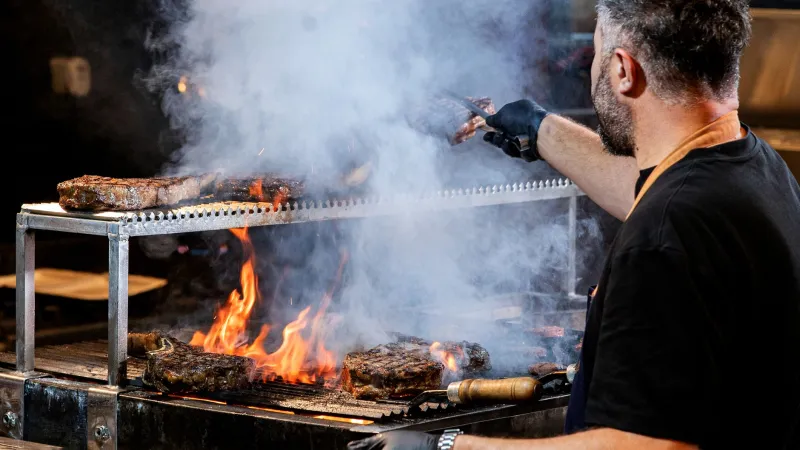
Chef Adaeze Okafor has built her Charleston, South Carolina restaurant, Ember & Tide, around a meticulous engagement with that tradition. Her tasting menu changes seasonally, but charcoal is the constant—a custom-built hearth at the center of the open kitchen anchors every course. Whole oysters are finished over white-ash charcoal and dressed with a smoked butter made from rendered heritage lard. A heritage grain pilau arrives beneath a thin sheet of charred cabbage leaf, its surface carrying the ghost of the fire.
"Lowcountry cooking is already sophisticated," Okafor says during a conversation in her dining room. "It doesn't need to be elevated in the sense of being made more complex. What I try to do is make its sophistication visible—to present it in a context where people slow down enough to taste what has always been there."
Ember & Tide earned its first Michelin star two years after opening. Okafor credits the charcoal hearth as the single most important element in the kitchen—not for drama, but for discipline. "Fire demands honesty," she says. "You cannot hide behind a sauce when the ingredient itself is the story."
Texas Mesquite and the Architecture of Smoke
In Austin, chef Ramón Castellanos has taken a different approach to the same fundamental challenge. His restaurant, Madera, draws from the mesquite-fire traditions of South and West Texas—a grilling culture defined by high heat, assertive smoke, and the primacy of beef—and channels them through a fine dining lens that is more concerned with restraint than elaboration.
At Madera, a single rib-eye from a Texas heritage ranch is the centerpiece of the tasting menu's main course. It is cooked entirely over mesquite charcoal, rested for an extended period, and served with two accompaniments: a small pot of beef tallow rendered from the trim, and a salsa verde made from charred tomatillos. Nothing else. The intention is to let the fire's work speak without interruption.
"There is a tendency, when you move barbecue into a fine dining context, to dress it up—to add the foam, the gel, the architectural garnish," Castellanos explains. "I think that impulse comes from insecurity. If the fire did its job, the meat doesn't need decoration. It needs space."
The critical response to Madera has been notable for the seriousness with which reviewers have engaged with its stripped-back philosophy. The restaurant holds two Michelin stars and was named one of the ten best new restaurants in America by a national food publication in its opening year.
Carolina Pit Tradition, Reframed
The whole-hog tradition of eastern North Carolina is perhaps the most ceremonially significant of all American barbecue practices. Cooking an entire pig over hardwood coals for twelve to eighteen hours is an act of community, patience, and technical precision—qualities that translate, perhaps more naturally than one might expect, to the fine dining context.
Chef Darius Whitfield of Coalfield in Durham, North Carolina, has built his restaurant's identity around that tradition without attempting to miniaturize or domesticate it. Coalfield operates a full pit on-site, and the whole-hog cook happens every week. The resulting meat appears on the menu in forms that honor the original while pushing toward something more considered: a terrine of smoked shoulder layered with pickled ramps and mustard seed gel; a consommé made from the pit drippings, clarified and served with a single piece of charred cornbread.
"The pit is not a prop," Whitfield is emphatic on this point. "Every dish on the menu comes from something that happened in that pit. The smoke is in the stock, the char is in the fat, the fire is in every plate we send out. If you took the pit away, the restaurant wouldn't exist."
Coalfield has become a destination for food travelers making deliberate pilgrimages to understand what American regional cooking looks like when taken seriously at the highest level.
Pacific Northwest Ember Cooking
Not all of the relevant regional traditions are rooted in the South or the Southwest. Chef Ingrid Solberg's restaurant Hearth & Stone in Portland, Oregon, draws from the ember-cooking practices of the Pacific Northwest—a tradition shaped by Indigenous food cultures, the extraordinary abundance of the region's forests, and a distinctive approach to cooking directly in and around coals rather than over them.
At Hearth & Stone, vegetables and proteins are frequently buried in the embers themselves—a technique that produces a dramatically different result from conventional grilling. Beets emerge from the coals with a deeply caramelized exterior and an almost custard-like interior. A whole trout, wrapped in leaves and placed directly in the coals, arrives at the table with a skin that has become something between a crust and a shell, protecting flesh of extraordinary delicacy.
"Charcoal is not one thing," Solberg says. "Most people think of it as something you put food above. But when you put food inside the fire—in the coals themselves—you get a completely different relationship between heat and ingredient. That is what I am exploring."
What This Moment Means
The restaurants profiled here share a commitment that goes beyond technique. Each has made a deliberate decision to treat American regional charcoal traditions not as raw material to be refined away, but as the intellectual and culinary foundation of their work. The smoke is not a flavoring agent—it is a point of view.
For the American fine dining landscape, this represents something meaningful: a growing confidence that the country's own culinary heritage, in its most elemental and historically grounded forms, is worthy of the same serious attention that has long been reserved for imported traditions. The charcoal hearth, it turns out, was always capable of producing extraordinary food. It simply required chefs willing to stand beside it and let it do its work.