The Aesthetics of Ash: How Today's Fine Dining Chefs Are Designing with Char
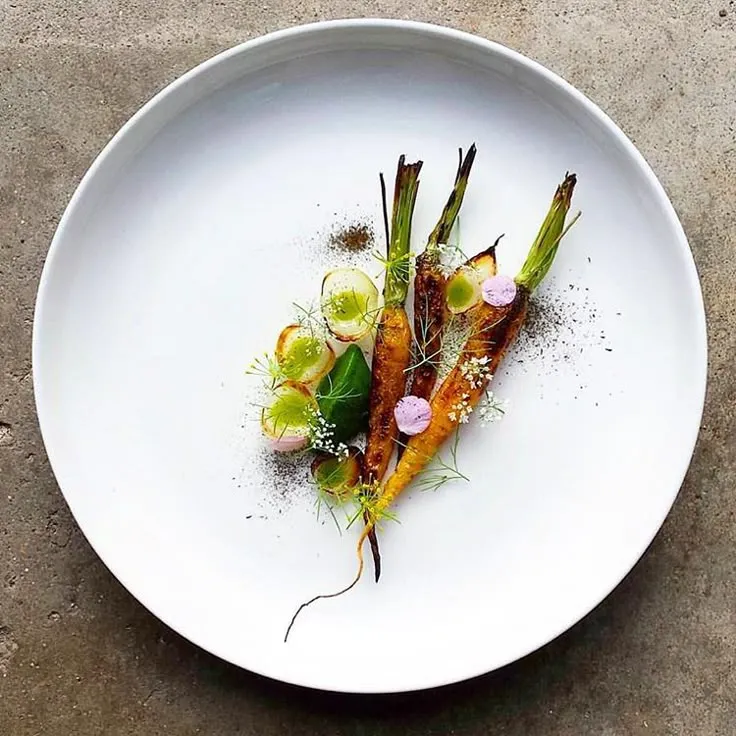
Photo: charred vegetable fine dining plating artistic presentation, via i.pinimg.com
Consider the leek. Roasted whole over charcoal until its outer layers surrender entirely to carbonization — blackened, papery, and structurally fragile — it arrives at the table looking, to the uninitiated, like something that has been forgotten on the grill. Then the server scores it lengthwise. The charred exterior falls away in dramatic sheets, revealing a silken, steam-cooked interior that carries the subtle perfume of smoke without a trace of bitterness. The contrast — ruin on the outside, revelation within — is not accidental. It is the entire idea.
This is charcoal dining as visual theater, and it represents one of the most sophisticated developments in contemporary American fine dining plating philosophy.
Char as Compositional Element
For much of culinary history, char occupied an ambiguous position in the hierarchy of cooking outcomes. A properly seared steak was celebrated for its crust; an over-charred one was sent back. The line between desirable browning and unwanted burning was drawn by convention as much as by chemistry, and it shifted according to who was doing the judging.
What has changed, in the most forward-looking charcoal-forward restaurants, is the recognition that char exists on a spectrum — and that different points along that spectrum produce distinct visual and gustatory effects that can be deployed with as much precision as a squeeze bottle or a mandoline. The Maillard reaction, which drives the browning of proteins and sugars under heat, and the deeper process of pyrolysis, which converts organic matter into carbon compounds, are not merely cooking phenomena. In the hands of a skilled chef, they are design tools.
Chef Simone Arquette of Cinder House in Chicago — a restaurant that has built its entire aesthetic identity around the interplay of fire and plating — describes her approach in explicitly visual terms. "When I think about a new dish, I think about where the darkness lives on the plate," she says. "Is it a border? Is it a texture contrast? Is it the primary surface? The char isn't decoration — it's structure."
The Grammar of Controlled Charring
Achieving intentional, reproducible char requires a technical vocabulary that goes well beyond simply placing food over high heat. The variables are numerous: the temperature and density of the charcoal bed, the distance between the grate and the embers, the moisture content of the ingredient, the duration of exposure, and whether the cooking is direct or indirect.
For vegetables, which have become the most photographically dramatic vehicles for char aesthetics in contemporary fine dining, the challenge lies in achieving carbonization at the surface while preserving structural and flavor integrity beneath. Whole onions, cabbages, beets, and root vegetables are frequently cooked in their skins directly in the embers — a technique with deep roots in traditional cooking across cultures, now refined by chefs who have developed precise protocols for timing and temperature.
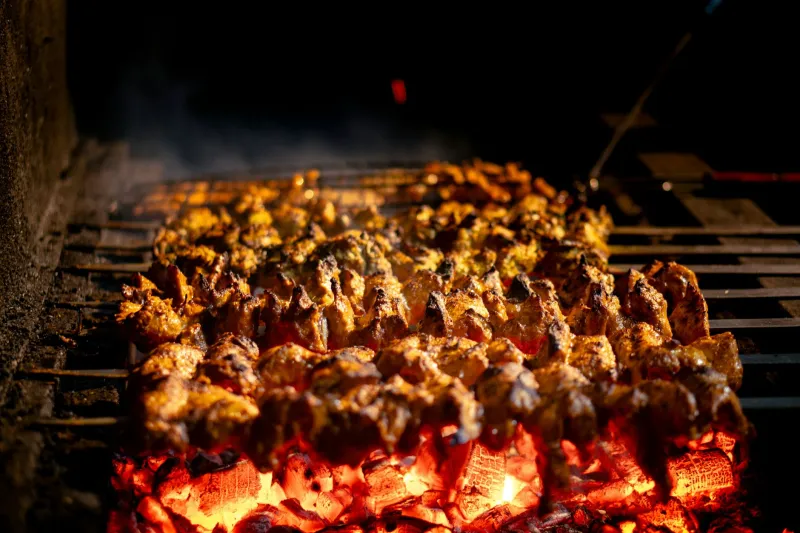
The char on a piece of octopus requires an entirely different approach. Here, the goal is the char mark — the grill's signature pressed into flesh — rather than full-surface carbonization. Achieving crisp, defined lines without overcooking the interior demands a charcoal bed burned down to consistent, medium-high embers and a practiced hand that knows when to turn and when to resist the urge.
For proteins, particularly beef and lamb, the relationship between char and crust is a study in controlled aggression. The Maillard crust on a properly grilled short rib or rack of lamb should be deeply bronzed at its edges, shading toward genuine char at the highest-heat contact points — dark enough to read as intentional, restrained enough to remain edible and complex rather than acrid.
Plating the Darkness
Once char has been achieved, the plating decision becomes a question of how to frame it. Contemporary fine dining has developed several recurring strategies.
The first is contrast maximalism: placing a deeply charred element against a background of extraordinary whiteness or pallor. A blackened corn cob section rested against a pool of cream-pale corn pudding; a charred spring onion laid across a smear of ricotta; a slab of coal-black eggplant beside a vivid green herb oil. In each case, the darkness of the char is amplified by its surroundings, becoming the visual anchor of the composition.
The second strategy is texture layering: using char to introduce a matte, rough-surfaced element into a plate that might otherwise read as uniformly smooth or glossy. The tactile contrast — visible even in a photograph — creates a sense of depth and dimensionality that mirrors the flavor contrast between charred exterior and yielding interior.
The third, and perhaps most conceptually ambitious, approach is what might be called char as the whole story. In these presentations — increasingly common at the avant-garde end of the tasting menu format — the charred state of an ingredient is the dish's primary visual and conceptual statement. A whole fish, served unadorned and entirely blackened, its flesh to be extracted tableside. A single charred tomato, split and dressed with nothing but good oil and sea salt, its carbonized skin peeled back to expose jewel-bright flesh.
The Psychology of the Burned Plate
There is a reason these presentations arrest the eye and linger in the memory: they carry an inherent narrative tension. Char signals destruction, and yet the dish is beautiful. It suggests excess, and yet it is precise. It evokes the primitive — fire, ash, the elemental act of cooking — and yet it arrives in a context of deliberate refinement.
Food psychologists have noted that visual complexity and apparent risk on the plate increase perceived value and sensory anticipation in diners. A charred element introduces both: it looks dangerous, and it requires the diner to trust that the chef has transformed apparent ruin into something extraordinary. When that trust is rewarded — when the blackened exterior gives way to something tender, smoky, and alive — the satisfaction is proportionally heightened.
Fire as Signature
For the chefs who have most fully committed to char as aesthetic language, the approach has become as identifying as a signature. Diners who have experienced Arquette's work, or the fire-forward plating of chefs like those at Brasero in Denver or Kindred in Davidson, North Carolina, recognize the visual grammar immediately: the specific quality of darkness, the deliberate placement of char marks, the architectural relationship between burned and unblemished.
This is what it means to cook with fire at the highest level — not merely to use charcoal as a heat source, but to allow the evidence of that fire to remain visible, intentional, and beautiful on every plate that leaves the kitchen.