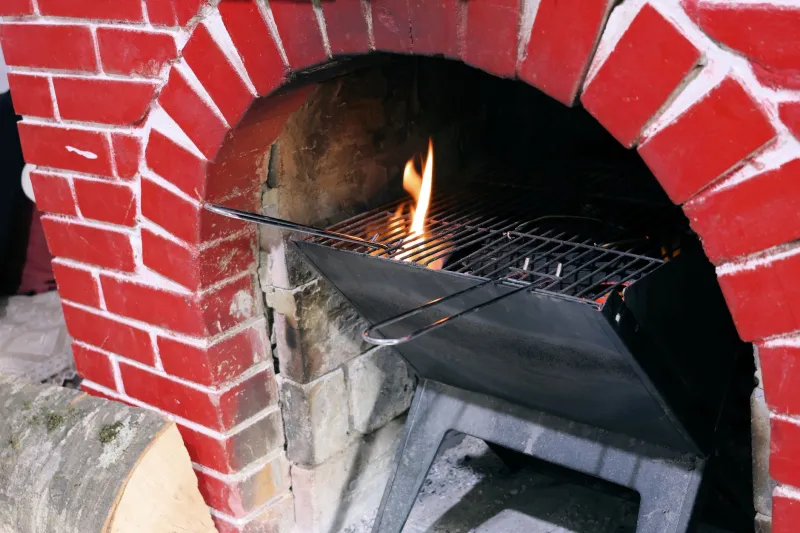
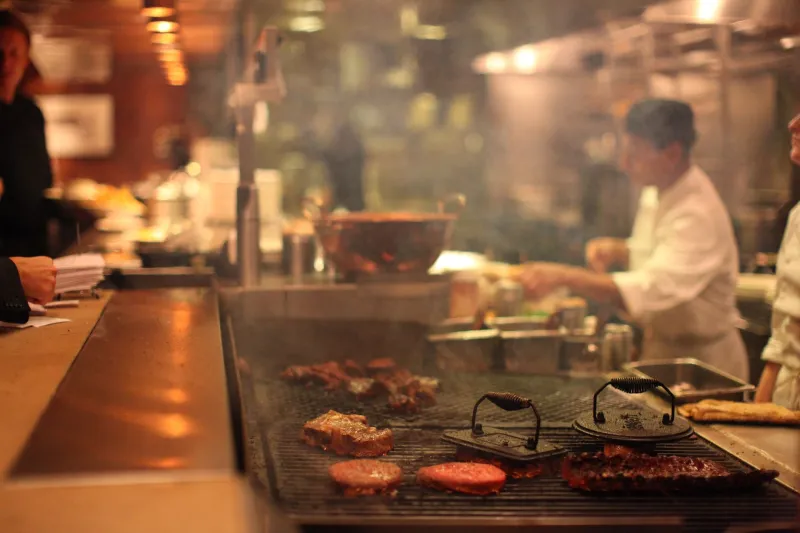
After the Fire: The Environmental Reckoning Facing America's Charcoal Restaurants
Every evening at a high-volume charcoal restaurant, before the first guest is seated, a quantity of fuel must be lit. In a busy kitchen operating five or six nights a week, that quantity adds up with surprising speed. A single full-service charcoal grill station might consume forty to sixty pounds of lump charcoal on a peak evening. Across a year, for a restaurant running multiple grill stations, that figure climbs into the tens of thousands of pounds.
This is the arithmetic that the live fire dining movement has not always been eager to examine. The romance of cooking over charcoal — the primal heat, the irreplaceable flavor, the drama of fire in a professional kitchen — is real and defensible on culinary grounds. On environmental grounds, the picture is more complicated, and a growing number of chefs and restaurateurs are beginning to grapple with it seriously.
The Carbon in the Coal
Charcoal is, at its most basic, a product of combustion. Wood or other organic material is heated in a low-oxygen environment — a process called pyrolysis — driving off moisture and volatile compounds and leaving behind a carbon-dense fuel that burns hotter and cleaner than raw wood. But the production process itself releases carbon dioxide, and the burning of charcoal in a kitchen releases more.
The carbon calculus depends heavily on sourcing. Charcoal derived from sustainably managed forests, where harvested trees are replaced through active reforestation, can be considered part of a relatively closed carbon cycle: the CO₂ released during burning was previously sequestered by the tree during its growth, and new trees will re-sequester it over time. Charcoal sourced from old-growth forests, or produced in regions where deforestation is ongoing, carries a significantly larger net carbon burden.
This distinction matters enormously, and it is one that the American fine dining industry has been slow to interrogate at the sourcing level. "Most chefs know what farm their carrots come from," observes Chef Daniel Reyes of Ascua in Houston, who has spent the past three years auditing his restaurant's fuel supply chain. "Almost none of them know what forest their charcoal came from, or whether that forest still exists."
The Import Problem
A significant share of the premium lump charcoal consumed in American restaurants is imported — from Paraguay, Argentina, and various nations in Central America and sub-Saharan Africa. Some of these supply chains are responsible and well-managed. Others are not, and the verification problem is substantial.
Certification programs such as those administered by the Forest Stewardship Council provide one framework for accountability, and a handful of domestic charcoal producers have pursued FSC certification as a market differentiator. But for restaurant operators purchasing charcoal through broadline distributors, the provenance of the fuel is rarely documented with the specificity that fine dining kitchens routinely demand of their food suppliers.
Reyes's audit process involved months of correspondence with distributors, direct outreach to producers, and, in several cases, visits to production facilities. The experience was instructive and, at times, disquieting. "We found one supplier we were genuinely proud of and two that we could no longer justify," he says. "The market has not caught up with the scrutiny that this ingredient deserves."
What Happens to the Ash
The downstream environmental question — what becomes of charcoal ash after service — has received even less attention than sourcing. A restaurant generating substantial ash volume on a nightly basis must dispose of it, and the options are more limited than most operators realize.
Charcoal ash is not inherently toxic, but it is alkaline, and in sufficient concentration it can disrupt soil chemistry if improperly composted or land-applied. Municipal solid waste disposal is the default for most operations — a solution that is functional but represents a missed opportunity. Properly cooled and composted charcoal ash, particularly from hardwood lump sources free of chemical additives, can serve as a soil amendment, raising pH in acidic soils in a manner analogous to agricultural lime.
Several restaurants in the Pacific Northwest and the mid-Atlantic have developed partnerships with urban farms and community gardens to redirect their ash output, transforming a waste product into a resource. At Grate & Ember in Portland, Oregon, the kitchen's ash is collected weekly and transferred to a network of community garden plots whose operators have verified soil pH compatibility. "It took about six months to set up," says the restaurant's operations director. "Now it's just part of the weekly rhythm."
Efficiency as Environmental Strategy
Beyond sourcing and disposal, a third axis of environmental engagement involves the efficiency of combustion itself. A poorly managed charcoal fire — lit too early, allowed to burn too hot for too long, inadequately banked between service periods — wastes fuel and generates unnecessary emissions. The discipline of fire management, long understood as a culinary skill, is increasingly recognized as an environmental one as well.
Some kitchens have moved toward kamado-style enclosed ceramic cookers for certain preparations, exploiting their exceptional insulation to dramatically reduce fuel consumption relative to open-grate cooking. Others have invested in high-quality grill infrastructure with adjustable grate heights and precision air-flow controls that allow cooks to modulate heat output without sacrificing additional charcoal.
Chef Reyes has calculated that improved fire management practices at Ascua reduced annual charcoal consumption by approximately eighteen percent without any measurable impact on cooking quality. "Efficiency is not a compromise," he argues. "A fire that burns correctly uses less fuel and cooks better. Those things are not in tension."
The Chefs Who Are Choosing Differently
For a small but vocal cohort of charcoal-driven restaurateurs, the environmental reckoning has prompted more fundamental changes. Several have begun working directly with regional producers to establish dedicated charcoal supply agreements that specify wood species, harvest practices, and production methods. A few have begun producing their own charcoal from wood waste — offcuts from butcher operations, prunings from kitchen garden orchards, salvaged urban timber — a practice that is labor-intensive but supply-chain transparent by definition.
These efforts do not resolve the fundamental tension between high-volume fire cookery and environmental responsibility. They do, however, represent a serious attempt to hold both commitments simultaneously — to cook with fire because fire produces something irreplaceable, and to do so with the full awareness of what that choice costs, and a genuine commitment to minimizing that cost.
"We built this kitchen around charcoal because we believe in what it does," Reyes says. "That belief doesn't give us a pass on the hard questions. If anything, it makes those questions more urgent. The fire is worth protecting. That means the forest has to be worth protecting, too."
The live fire movement has always understood itself as a return to something essential. The environmental conversation now unfolding within it suggests that the return must extend further — past the romance of the flame, and into the full accounting of what it takes to keep it burning.