Course by Course, Coal by Coal: The American Chefs Reinventing the Tasting Menu Over Live Fire
The tasting menu has long occupied a particular throne in American fine dining — a format that signals ambition, invites narrative, and offers a chef the rarest of opportunities: the chance to tell a complete story across a dozen or more courses. It is also, historically, a format built on the infrastructure of the conventional kitchen, with its reliable ovens, precise induction burners, and the kind of environmental control that allows a pastry team to work with confidence three feet from a sauté station.
A handful of American chefs have decided to dismantle that infrastructure entirely.
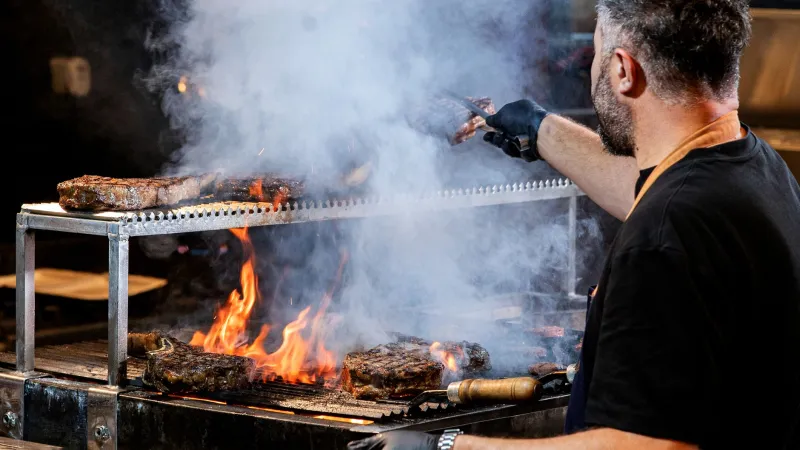
At restaurants quietly rewriting the rules from Brooklyn to Portland, from Austin to the Bay Area, the tasting menu is being reconstructed from the ground up — every course conceived, developed, and executed over live charcoal fire. The results are extraordinary. The process, those who pursue it will tell you, is among the most demanding undertakings in contemporary American cuisine.
The Architecture of a Fire-Driven Menu
Designing a tasting menu around charcoal is, at its core, an exercise in creative constraint. The chef cannot rely on a sous vide bath to hold a protein at a precise temperature while a sauce reduces nearby. There is no convection oven standing by as a safety net. Every decision — every protein, every vegetable, every sauce, every element on every plate — must be reconceived through the lens of what fire can do, and what it cannot.
Chef Marcus Hale, whose twelve-seat restaurant in Austin, Texas operates exclusively around a custom-built charcoal hearth, describes the development process as "cooking backward from the fire."
"Most chefs start with an ingredient and ask how to cook it," Hale explains. "We start with the fire and ask what it wants to do today. That might sound abstract, but it's actually very practical. The fire has a personality. Our job is to build a menu that works with it, not against it."
Hale's current tasting menu runs eleven courses, each one involving direct or indirect charcoal heat at some stage of preparation. An opening course of ember-roasted beet arrives with a cultured cream kissed by the smoke of smoldering hardwood. A mid-menu interlude features whole quail, spatchcocked and grilled over white oak charcoal, served alongside a reduction built from the drippings collected beneath the grate. Even the dessert course — a dark chocolate preparation finished with sea salt — incorporates a charcoal-smoked caramel that the kitchen develops in small batches each afternoon.
The Technical Demands of Consistency
Perhaps the most formidable challenge facing chefs who pursue this format is consistency. In a traditional tasting menu restaurant, consistency is already a demanding standard — every plate for every guest at every table must meet the same specification, night after night. When the cooking medium is live fire, that standard becomes exponentially more difficult to uphold.
Charcoal burns differently depending on its origin, its moisture content, the ambient temperature of the kitchen, and the frequency with which the grill is opened during service. A cook managing a station over live coals must develop an almost intuitive understanding of heat zones, knowing instinctively when to move a piece of fish two inches to the left or to raise a grate by a quarter turn to avoid overcooking.
"We run two dedicated fire managers during every service," says Chef Dominique Reyes, whose eight-course tasting menu at her San Francisco restaurant has attracted considerable attention since debuting last year. "Their only job is to maintain the fire — building it, managing the coal beds, rotating fresh charcoal in as needed. The cooking team doesn't touch the fire. They cook on it. That division of labor was the thing that finally allowed us to reach the consistency we needed."
Reyes's approach reflects a broader organizational philosophy emerging among charcoal-focused tasting menu restaurants: the recognition that live fire cooking at this level of precision requires a level of specialization that most kitchens have never had to develop.
A New Kind of Culinary Theater
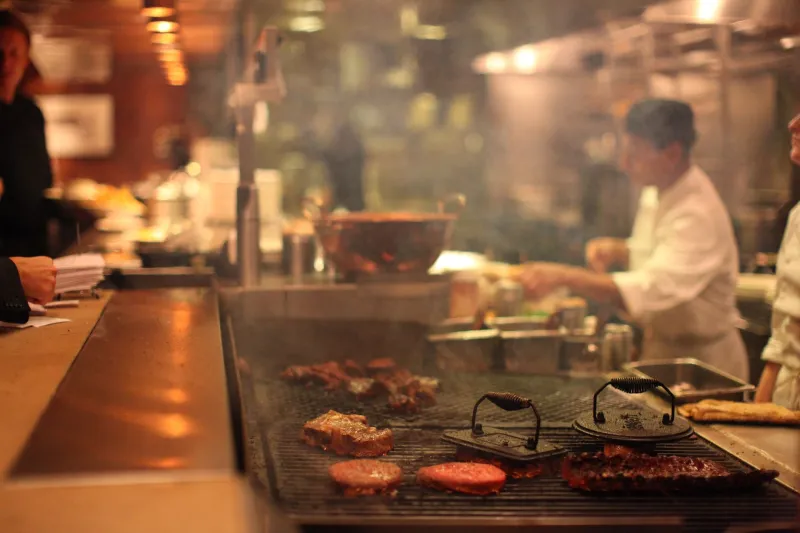
If consistency is the technical challenge, theater is the unexpected reward. Guests who come to a charcoal-forward tasting menu restaurant arrive to experience something that is, by definition, impossible to fully replicate at home or in a conventional dining environment. The visual and sensory experience of watching a kitchen team work around a glowing hearth — the controlled intensity, the focused choreography, the smell of smoke threading through a beautifully appointed dining room — creates an atmosphere that no amount of tableside preparation or elaborate plating can match.
Several restaurants in this space have deliberately designed their dining rooms to maximize this effect. Open kitchens face the main dining area directly, with the charcoal hearth positioned as a focal point rather than concealed behind a pass. Some have installed elevated viewing counters that allow guests to observe the fire station up close during service, transforming a working kitchen into something closer to a live performance.
"Our guests often tell us they feel like they're watching something real," says Hale. "Not staged. Not performative. They're watching cooks who are genuinely working — reading the fire, making decisions, adapting in real time. That's not something you can manufacture. It either happens or it doesn't."
Who Is Coming to the Table
The audience for charcoal tasting menus is, by most accounts, notably different from the traditional fine dining clientele. While established food enthusiasts remain a core constituency, chefs and restaurateurs in this space report a striking influx of younger diners — guests in their late twenties and thirties who are arriving with deep knowledge of grilling technique, charcoal sourcing, and live-fire cooking traditions, and who are seeking a restaurant that takes those subjects as seriously as they do.
This is a generation that grew up watching live-fire cooking on streaming platforms, that has followed the careers of American grill-focused chefs with something approaching fandom, and that brings to the dining room a level of engagement and curiosity that rewards the kind of detailed, ingredient-driven storytelling that a tasting menu format allows.
"They ask questions I never expected fine dining guests to ask," says Reyes. "What kind of charcoal are we using tonight? How long did we let the coals develop before service? What temperature is the hot zone running at? These are conversations I used to have with other chefs. Now I'm having them with guests at table six."
The Format's Future
The charcoal tasting menu remains, for now, the province of a relatively small number of deeply committed chefs. The barriers to entry are real — the investment in infrastructure, the demands on staff, the complexity of menu development, and the relentless operational pressure of maintaining live fire through a multi-hour service are not challenges that every kitchen is equipped to meet.
But the momentum is unmistakable. As these restaurants earn recognition — from critics, from industry peers, and from the guests who return with the fervor of converts — the format is gaining a legitimacy that positions it not as a novelty but as a genuine evolution of American fine dining.
The tasting menu was always, at its best, an act of ambition. In the hands of these chefs, it has become something more: an act of faith in the oldest cooking method known to the human species, elevated with the precision, creativity, and intention that define the finest dining experiences in the country today.