Beyond the Grill: Why the Finest American Restaurants Now Treat Charcoal as a Premium Ingredient
For decades, the conversation around fine dining focused on provenance — where the wagyu was raised, which farm produced the heirloom tomatoes, which cooperative supplied the finishing salt. Yet one foundational element of the cooking process itself remained largely invisible to that scrutiny: the fuel. That invisibility is rapidly dissolving. Across the United States, a growing cohort of serious culinary establishments has begun treating charcoal with the same exacting attention traditionally reserved for the ingredients it transforms.
The shift is not merely aesthetic. It is rooted in a deepening understanding of how combustion chemistry interacts with proteins, fats, and sugars at the molecular level — and how different fuel sources produce markedly different results on the plate.
The Quiet Revolution Beneath the Grate
Walk into the back-of-house operations at a number of top-tier American restaurants today, and you may find something unexpected alongside the dry-aged cuts and hand-harvested sea vegetables: carefully labeled bags and crates of charcoal, sorted by origin, density, and intended application. Chefs who once ordered whatever commercial briquettes arrived on the supply truck are now maintaining relationships with specialty fuel suppliers in much the same way a sommelier cultivates relationships with wine importers.
This evolution has been driven by a simple, repeatable observation: the fuel changes the food. Not subtly, but in ways that trained palates detect immediately. The carbon content of the charcoal, the moisture level at the time of combustion, the density of the wood from which it was produced — each variable contributes to the temperature arc of the fire, the presence or absence of off-notes in the smoke, and ultimately the depth and character of the flavor delivered to the guest.
Hardwood Lump: The American Standard, Elevated
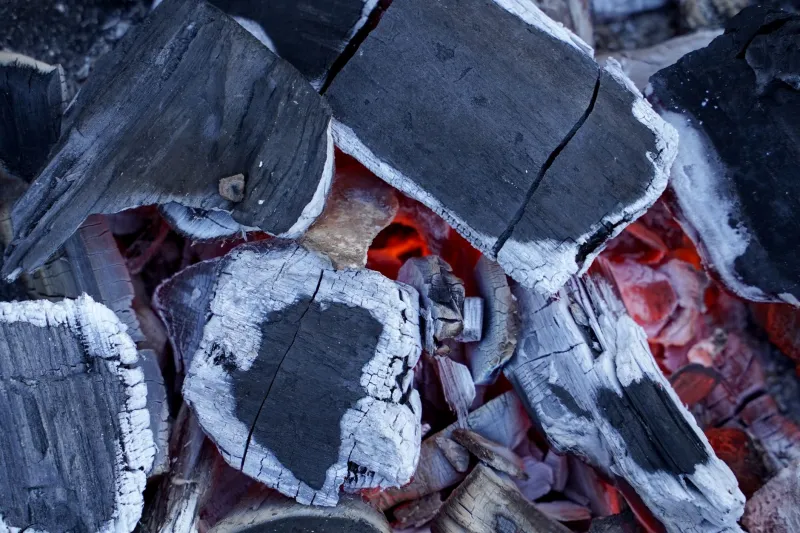
Hardwood lump charcoal — produced by burning whole pieces of wood in a low-oxygen environment — has long been the preferred choice of American backyard enthusiasts who prize its clean burn and authentic wood character. In fine dining contexts, however, the category has been refined considerably. Restaurants in cities like Nashville, Charleston, and Chicago are now specifying not just "hardwood lump" but particular species: white oak for its long, even burn and subtle vanilla undertones; hickory for its assertive, smoky backbone; pecan for a gentler, slightly sweet aromatic profile.
Some suppliers have responded to this demand by offering single-origin lump charcoal — fuel produced from trees harvested in a specific region, with documented burn characteristics and moisture content. For chefs building tasting menus around a single protein prepared over live fire, this level of specificity is not indulgence; it is craft.
Binchotan: The Japanese Import Reshaping American Fire Kitchens
Perhaps no single fuel source has done more to elevate the conversation around charcoal quality in the United States than binchotan, the dense, centuries-old Japanese charcoal produced primarily from ubame oak in the Wakayama Prefecture. Traditionally associated with yakitori and kaiseki preparations, binchotan burns at extraordinarily high temperatures — sometimes exceeding 1,500 degrees Fahrenheit — while producing almost no smoke and virtually no odor. The result is a radiant, infrared-style heat that sears proteins with exceptional precision, developing a crust of remarkable depth without introducing any combustion flavor.
American chefs have embraced binchotan enthusiastically, though not without confronting its considerable cost. Premium binchotan can run several times the price of domestic hardwood lump, and its ignition process — which requires a dedicated charcoal chimney and significant lead time — demands operational discipline. Restaurants in New York, Los Angeles, and San Francisco that have integrated binchotan into their live-fire programs often treat it as a dedicated station fuel, reserved for the most delicate preparations: A5 wagyu, whole fish, and aged duck breast, where the absence of intrusive smoke allows the ingredient's own character to dominate.
The Briquette Question
Conventional wisdom in culinary circles has long dismissed commercial briquettes — the compressed, additive-laden blocks that dominate the mass market — as unsuitable for serious cooking. That dismissal, while largely warranted in the context of standard commercial products, has begun to invite a more nuanced conversation. A new generation of premium briquettes, produced without chemical binders and composed entirely of compressed hardwood char, has entered the professional market. These products offer the consistency and predictability that lump charcoal sometimes lacks, without the petroleum-derived off-flavors associated with their conventional counterparts.
For high-volume live-fire kitchens managing multiple covers across an evening service, this consistency carries real operational value. Knowing that a briquette will maintain a specific temperature range for a predictable duration allows line cooks to execute with confidence — a consideration that pure lump charcoal, with its variable density and irregular shape, does not always afford.
Grading, Sourcing, and the Supplier Relationship
The emergence of charcoal as a premium ingredient has given rise to a small but growing network of specialty fuel suppliers catering specifically to professional kitchens. Companies like Fogo Premium Charcoal, Jealous Devil, and several regional producers have developed trade relationships with restaurants that mirror those between purveyors and chefs in other ingredient categories — including seasonal offerings, custom blends, and direct communication about sourcing and production methods.
Some establishments have taken this a step further, visiting production facilities to evaluate manufacturing processes firsthand. The questions they bring would be familiar to any chef conducting a farm visit: How is the raw material selected? What quality controls govern moisture content? How is the finished product stored and transported? These are not abstract concerns. Charcoal that has absorbed ambient moisture during storage burns cooler and less cleanly, producing steam alongside combustion gases and compromising the sear that defines live-fire cuisine at its best.
Flavor as the Final Argument
The most persuasive case for charcoal as a genuine culinary ingredient is made not in supply chain conversations or chemistry textbooks, but on the plate. Guests at restaurants that have invested in premium fuel sourcing may not be able to articulate precisely what distinguishes the experience — but experienced diners consistently note a cleanliness to the char, a layered quality to the smoke, and an integration between crust and interior that less carefully fueled preparations rarely achieve.
This is the core proposition of the charcoal renaissance now unfolding in American fine dining: that the fire is not merely a cooking mechanism, but a collaborator. The fuel that feeds it is not infrastructure — it is ingredient. And like every great ingredient, it rewards the chef who takes the time to understand it.
At Charcoal Dining, we have always believed that the distance between good and extraordinary is measured in details. The charcoal beneath the grate is one of the most consequential details in live-fire cuisine, and the chefs who recognize that are producing some of the most compelling food in the country today.