The Art of Deliberate Darkness: How American Chefs Are Turning the Char Into a Signature
For most of culinary history, the blackened surface was a confession. It told a story of distraction, of heat mismanaged, of a cook whose attention had wandered at precisely the wrong moment. The carbon crust was scraped away before the plate left the pass, an imperfection excised rather than examined. The assumption was simple and seemingly self-evident: burning was failure.
That assumption is no longer operative in the most serious American kitchens.
Across the country, a growing cohort of chefs working with charcoal and live fire has arrived at a more nuanced understanding — one in which carbonization, applied with precision and intention, produces sensory outcomes that no other technique can replicate. The char is no longer hidden. In many instances, it is the centerpiece.
A Cultural Shift, Measured in Degrees
The rehabilitation of char as a culinary virtue did not happen suddenly. It was, rather, the accumulated result of several converging forces: the broader American embrace of live-fire cooking traditions from Mexico, South America, and Japan; the influence of chefs like Francis Mallmann, whose philosophy of elemental fire cooking reached American audiences with considerable force; and a generational shift in fine dining toward techniques that prioritize authenticity and sensory intensity over classical refinement.
In the American context, there is also a deeper cultural lineage to acknowledge. The tradition of intentional charring runs through Southern barbecue, through the blackened Cajun technique popularized by Paul Prudhomme in the 1980s, through the pit-roasted traditions of indigenous communities across the continent. What contemporary fine dining chefs have done, in part, is retrieve these traditions, strip away any association with carelessness, and reframe them as the sophisticated techniques they have always been.
The result is a culinary landscape in which a visibly darkened leek, a deliberately scorched tomato, or a beef cut with a crust that approaches true black at its edges is not a liability but a statement of intent.
The Chemistry of Controlled Carbonization
Understanding why intentional charring works requires a brief excursion into food chemistry — specifically, the distinction between the Maillard reaction and pyrolysis, two processes that are often conflated but operate at different temperatures and produce meaningfully different results.
The Maillard reaction, which begins around 280 to 330 degrees Fahrenheit and is responsible for the golden-brown crust on a perfectly seared steak, involves the interaction between amino acids and reducing sugars to produce hundreds of flavor compounds. It is the foundation of most high-heat cooking and is well understood by any trained cook.
Pyrolysis — the partial combustion that produces true char — occurs at significantly higher temperatures, typically above 400 degrees Fahrenheit, and involves the breakdown of organic compounds into simpler molecules, including carbon. The flavor compounds produced in this range include a family of chemicals called pyrazines, which are responsible for the distinctly roasted, bitter, and complex notes associated with intentional char. These compounds are also present in coffee, dark chocolate, and toasted grains, which is why a well-charred vegetable or piece of meat can evoke those flavors in ways that a merely browned surface cannot.
The key insight, understood intuitively by skilled live-fire cooks for generations and now increasingly validated by food science, is that the bitterness introduced by controlled charring functions as a flavor counterpoint rather than a flaw. It provides contrast to sweetness, depth to richness, and a structural complexity that keeps the palate engaged across multiple bites.
Technique in Practice: What Chefs Are Actually Doing
The techniques through which intentional charring is achieved in a fine dining context vary considerably depending on the ingredient, the desired outcome, and the specific qualities of the charcoal being used.
For vegetables — particularly alliums, brassicas, and root vegetables — direct placement on or within the coals themselves is among the most effective approaches. A whole onion buried in embers and left to cook until its outer layers are fully carbonized will, upon removal, reveal an interior that has been effectively steam-cooked in its own juices, impossibly sweet and tender, with a smoky depth that no other method produces. The charred exterior, often discarded in less deliberate preparations, is increasingly being used in its own right: pulverized into powders, steeped in oils, or incorporated into sauces where its bitter, mineral character provides ballast.
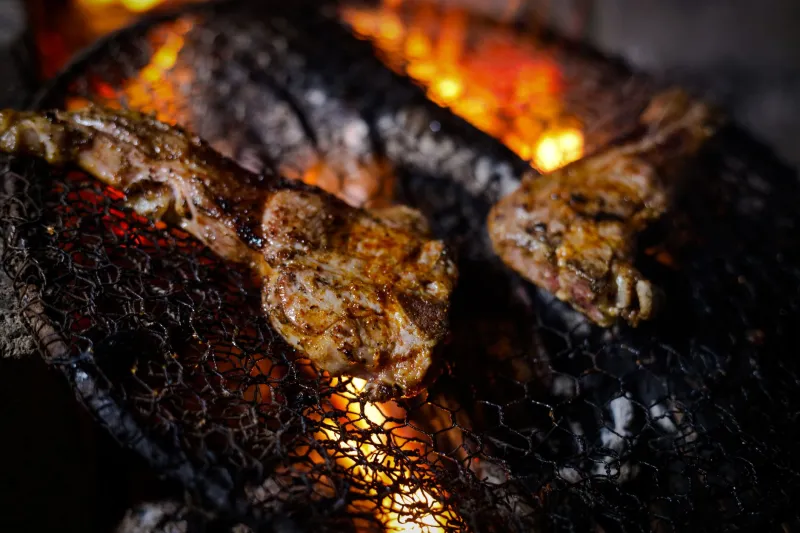
For proteins, the challenge is more technically demanding. Achieving a genuinely charred exterior without compromising the interior requires precise control of heat zones — a skill that charcoal, with its capacity for significant temperature variation across a single grate, rewards in ways that gas cannot. Chefs describe working in layers: building a deep, even sear over a high-heat zone, then moving the protein to a lower-heat area to allow the interior to reach its target temperature without the surface progressing further into carbonization. The margin between a masterfully charred crust and an overcooked interior is narrow, and navigating it consistently is regarded by many live-fire cooks as among the most demanding skills in the kitchen.
Fruit — particularly stone fruits, citrus, and pineapple — occupies its own category within the intentional charring canon. The natural sugars present in ripe fruit caramelize rapidly and, when pushed further, develop a bittersweet char that creates remarkable tension in both savory and dessert applications. Charred peach alongside a rich pork preparation, or a blackened grapefruit half finished with a touch of aged spirits, represents a flavor logic that is simultaneously intuitive and unexpected.
The Sensory Case for Darkness
Beyond the chemistry, chefs who work extensively with intentional charring speak about its sensory contributions in terms that go beyond flavor alone. Texture is equally significant. A properly charred surface introduces a crispness and structural contrast that heightens the perception of tenderness in the interior. The visual impact of a deeply darkened exterior against a vibrant interior — the cross-section of a charred carrot revealing vivid orange flesh, or a blackened exterior on a fish fillet giving way to translucent, barely-set protein — is a form of culinary drama that resonates with diners in ways that are difficult to achieve through other means.
There is also something more abstract at work. The char carries with it a legibility — a visible record of the fire, the heat, the moment of transformation. It makes the cooking process apparent in a way that more controlled techniques do not. For diners who have come to value transparency and authenticity in their dining experiences, a dish that bears the honest marks of live fire communicates something that a flawlessly uniform preparation, however technically accomplished, cannot.
From Mistake to Mastery
The reclassification of the char — from evidence of error to expression of mastery — reflects a broader maturation in American fine dining's relationship with live fire. As charcoal cookery has moved from the margins to the center of serious culinary discourse, the techniques associated with it have been subjected to the same rigorous scrutiny and refinement that classical French methods received in previous generations.
The result is a body of practice in which burning, far from being avoided, is pursued with discipline, studied with curiosity, and presented with pride. In the most accomplished American charcoal kitchens, the darkest corner of the plate is often where the most interesting work is happening.