Less Fury, More Fire: The Counterintuitive Truth About Building a Serious Home Charcoal Setup
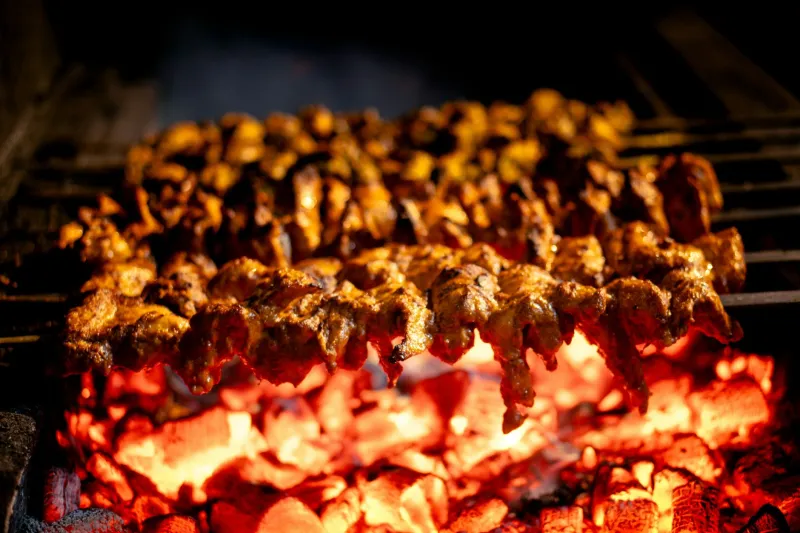
There is a particular kind of confidence that overtakes a home cook the first time they pour a full chimney of glowing coals into a kettle grill, watch the grates begin to shimmer, and feel the wave of heat rise against their forearm. It feels like power. It feels, unmistakably, like the right way to begin.
It is almost always the wrong way to begin.
Across the country, equipment designers, seasoned home enthusiasts, and the professionals who consult for both groups are quietly united on a point that contradicts nearly every instinct a new charcoal cook develops: the pursuit of maximum temperature is not the path to exceptional food. Control is. And control, almost by definition, means learning to want less heat than you think you need.
The BTU Myth and Why It Persists
Walk into any hardware store or scroll through any grilling forum, and you will encounter the language of BTUs — British Thermal Units — deployed as the primary measure of a grill's worthiness. Higher numbers are marketed as superior. Consumers respond accordingly.
The problem, as Marcus Ellroy, an independent grill and hearth equipment designer based in Asheville, North Carolina, explains, is that BTU ratings were borrowed from the gas appliance world and never translated cleanly to charcoal cookery. "Gas is a closed system," Ellroy says. "You dial it up, you dial it down, and the output is predictable. Charcoal is a living system. The fuel is constantly changing state, and the variables that matter most — airflow, coal density, bed depth, moisture content — have almost nothing to do with the theoretical maximum heat your setup can generate."
In practice, the home cook obsessed with BTU output will build a fire that burns aggressively, exhausts its fuel quickly, and offers a narrow window of usable cooking time before the temperature either spikes beyond control or drops precipitously. Neither outcome produces the sustained, even heat that distinguishes a properly charcoal-cooked piece of protein from one that has merely been exposed to fire.
What Restaurant Kitchens Actually Do
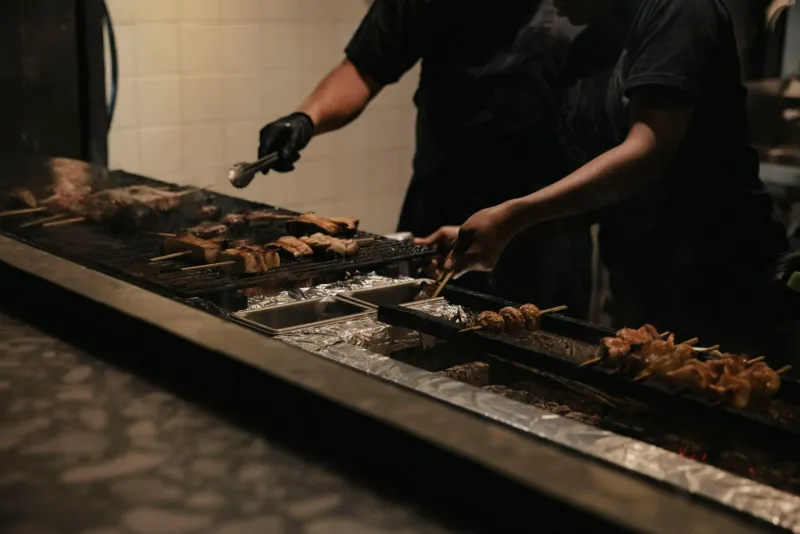
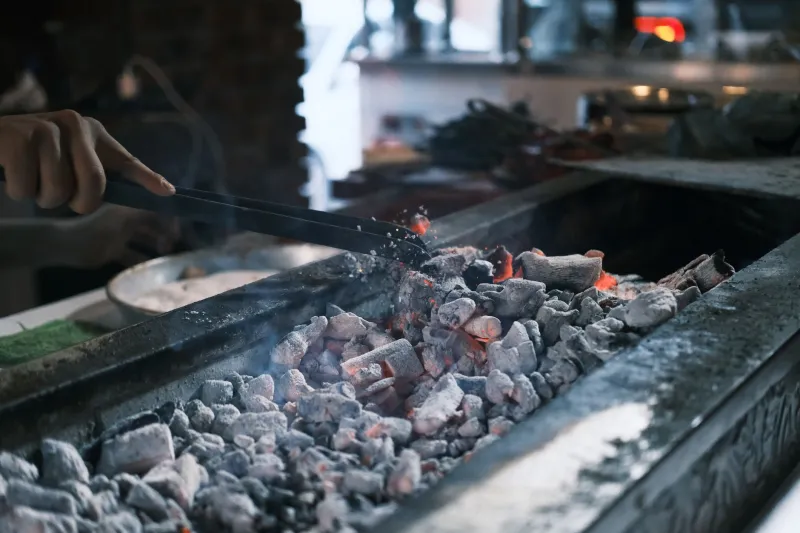
The charcoal kitchens that have earned serious culinary recognition in American fine dining share a discipline that is rarely discussed in home grilling circles: they manage their fires as carefully as they manage their mise en place. Coal beds are prepared well in advance. Temperatures are allowed to stabilize before any food is introduced. Airflow is adjusted in small increments rather than dramatic gestures.
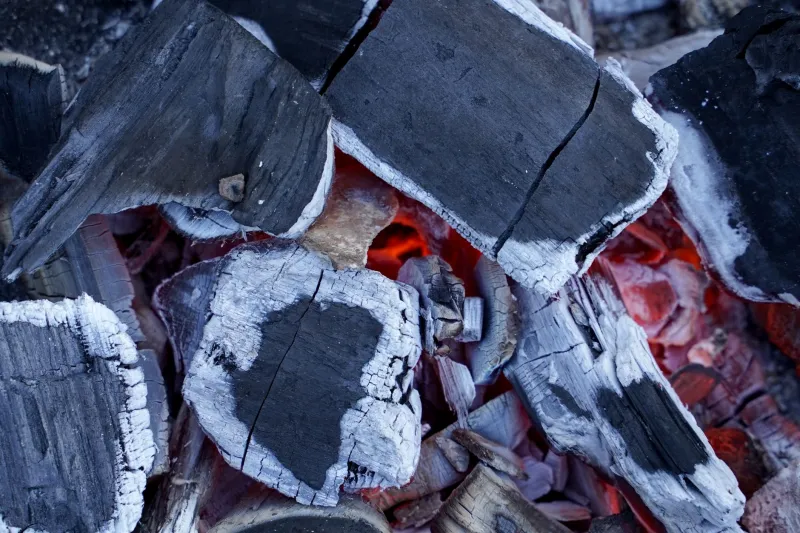
This patience is not incidental. It is structural. A properly constructed charcoal bed — whether in a custom-built hearth or a well-maintained kettle grill — will radiate heat more evenly and more consistently once the initial combustion phase has passed and the coals have settled into a steady, glowing state. The aggressive orange flame that excites a first-time griller is, in technical terms, the least useful part of the fire.
"What you want is the ember stage," says Diane Kowalczyk, a Chicago-based home cook who has spent several years refining her backyard setup after a series of cooking classes at a live-fire restaurant. "The coals look almost gray on the outside. There's no visible flame. That's when the heat is actually consistent enough to do real work."
Kowalczyk now cooks on a ceramic kamado-style grill, but she is careful to note that the equipment itself was secondary to the change in mindset. "I cooked on a basic kettle for two years after I understood the principles, and the food was genuinely better than anything I'd produced on fancier equipment when I didn't know what I was doing."
Airflow Is the Real Dial
If BTU obsession is the first misconception that undermines home charcoal cooking, airflow mismanagement is the second — and arguably the more consequential one.
Every charcoal grill, from the most basic three-legged kettle to a precision-engineered ceramic cooker, is fundamentally a combustion chamber. The rate at which fuel burns is governed almost entirely by the volume of oxygen introduced and exhausted. Bottom vents feed the fire; top vents regulate the draw. The relationship between the two determines whether your cooking temperature rises, falls, or holds steady.
Most home cooks, Ellroy observes, treat their vents as binary: fully open when they want heat, fully closed when they want to extinguish the fire. The range of cooking that becomes possible when vents are used as precision instruments — partially open, asymmetrically adjusted, fine-tuned over the course of a cook — is dramatically wider. "The difference between a grill that can do one thing and a grill that can do many things is almost never the hardware," he says. "It's whether the person using it has learned to think of airflow as their primary control mechanism."
For indirect cooking — the method that produces the most consistently impressive results with larger cuts of meat, whole birds, and fish — this becomes especially important. A two-zone fire, with coals banked to one side and the food positioned on the cooler side of the grate, requires careful vent management to maintain a steady ambient temperature over an extended cook. Too much air and the fire runs hot; too little and it struggles to sustain itself.
Building the Setup Around Patience
For home cooks looking to invest in equipment that supports this philosophy rather than working against it, a few principles are worth establishing before any purchasing decisions are made.
First, thermal mass matters. Thicker grill walls and ceramic or cast-iron construction retain heat more effectively than thin steel, which means temperatures stabilize more readily and recover more quickly after the lid is opened. This is the genuine functional advantage of premium kamado-style cookers — not their maximum temperature potential, but their thermal stability.
Second, a quality chimney starter is not optional. Lighting charcoal with lighter fluid introduces combustion variables and flavor contaminants that undermine the entire exercise. A chimney allows coals to reach a uniform, fully-lit state before they are introduced to the grill, which means the cook begins with a predictable baseline rather than a chaotic one.
Third — and this is the recommendation that surprises most people — a reliable instant-read thermometer designed for ambient temperature monitoring is as valuable as any grill accessory on the market. Cooking by feel is a skill that develops over years. Cooking with accurate data is a skill that can be applied immediately.
The Discipline That Separates Good from Exceptional
The restaurants that have built reputations around charcoal cookery in the United States did not do so by finding hotter fuel or more powerful equipment. They did it by developing a culture of attentiveness around fire — treating the grill as something to be read and responded to rather than simply ignited and walked away from.
That discipline is entirely available to the home cook. It requires no particular budget and no specialized training. It requires only a willingness to relinquish the intuition that more heat means better results, and to replace it with something quieter and more demanding: the patience to let the fire tell you when it is ready.
The best charcoal cooks, whether they are working in a nationally recognized restaurant kitchen or a backyard in suburban Ohio, share one habit above all others. They wait. They watch the coals. And they do not rush what the fire has not yet finished doing.