The Quiet Fire: Why America's Best Charcoal Chefs Are Turning the Heat Down
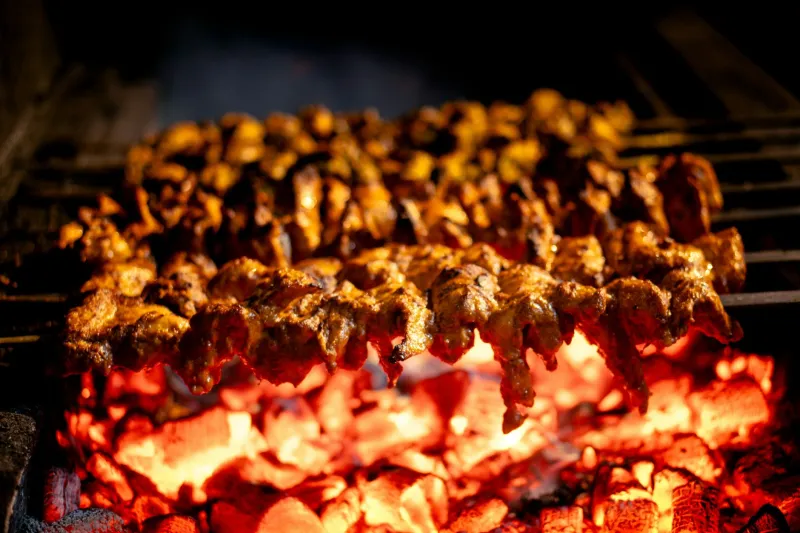
There is a persistent mythology surrounding charcoal cookery — one forged in backyard legend and reinforced by decades of culinary shorthand — that equates a roaring, radiant fire with mastery. The louder the sear, the thinking goes, the better the cook. Yet walk into a growing number of Michelin-recognized restaurants across the United States, and you will find something that quietly defies that assumption: fires that glow rather than rage, temperatures held with watchmaker precision, and finished plates that carry a complexity no inferno could ever produce.
This is not timidity. It is discipline. And it is reshaping the way serious American chefs think about the relationship between charcoal and cuisine.
The Thermodynamics of Restraint
To understand why lower temperatures can yield superior results, it helps to consider what extreme heat actually does to food at a molecular level. When proteins encounter temperatures above 400°F in rapid succession, surface moisture evaporates almost instantly, and the Maillard reaction — the cascade of browning chemistry responsible for crust and flavor development — accelerates beyond the point of control. The result is often a beautiful exterior concealing an interior that has been compromised: fibers tightened, juices expelled, and the more delicate aromatic compounds burned away before they ever reach the palate.
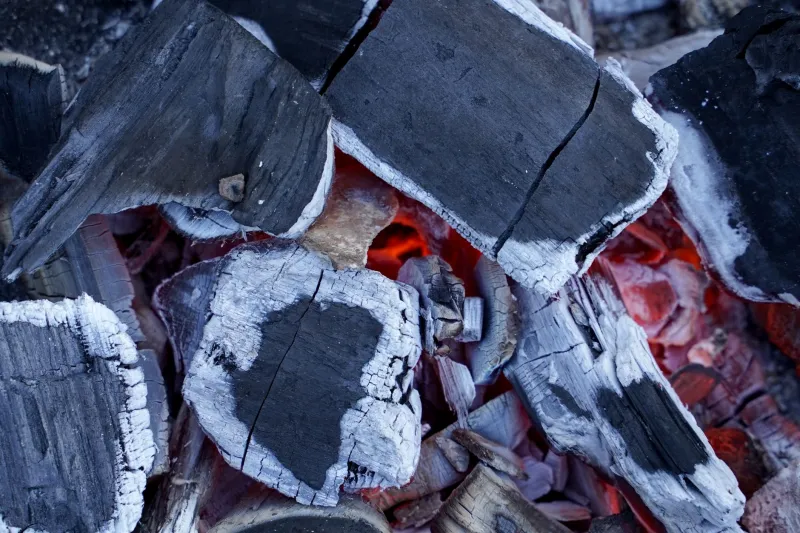
A fire held between 275°F and 350°F behaves entirely differently. Moisture migrates more gradually. The Maillard reaction proceeds at a pace that allows dozens of distinct flavor compounds to develop in sequence rather than simultaneously combusting into a single dominant char note. Fat renders with patience, basting the protein from within. And crucially, the volatile aromatic molecules released by the charcoal itself — the compounds that give live-fire cooking its singular identity — have time to adhere to the food's surface rather than being vaporized by their own intensity.
"Heat is a tool, not a goal," says one Chicago-based chef whose wood-and-charcoal kitchen has earned consistent recognition from the James Beard Foundation. "When I stopped chasing the highest possible temperature and started asking what temperature each specific ingredient actually needed, everything changed."
Engineering the Controlled Burn
Achieving a precisely modulated charcoal fire is considerably more demanding than simply letting one burn hot. It requires an intimate understanding of fuel behavior — how different charcoal densities and moisture contents affect heat output, how airflow interacts with ember beds of varying depths, and how the geometry of the grill itself creates thermal zones that can be exploited or avoided depending on what is being cooked.
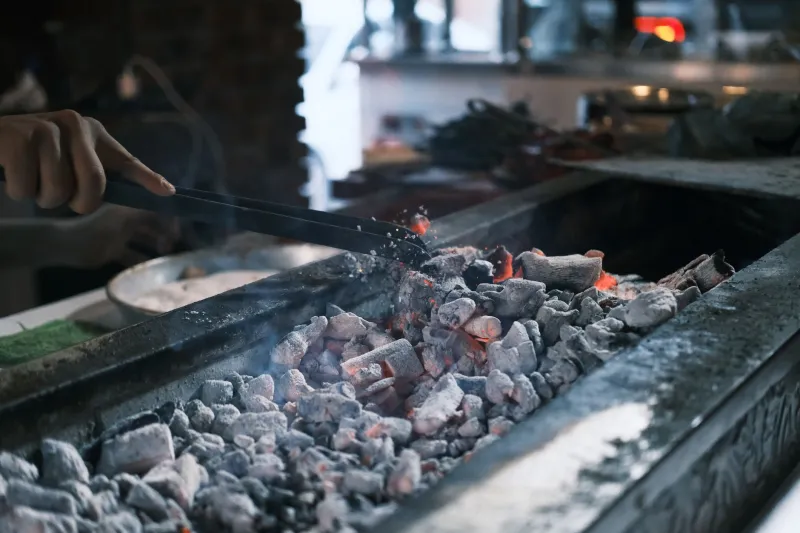
Many of the chefs pioneering this approach have invested in custom-fabricated hearths designed specifically for temperature stratification. Rather than a single cooking surface, these rigs feature tiered grates positioned at calibrated distances from the coal bed, allowing a cook to move proteins through distinct thermal environments during a single preparation — beginning over moderate radiant heat to develop the exterior, then migrating to a cooler zone where convective warmth finishes the interior without stress.
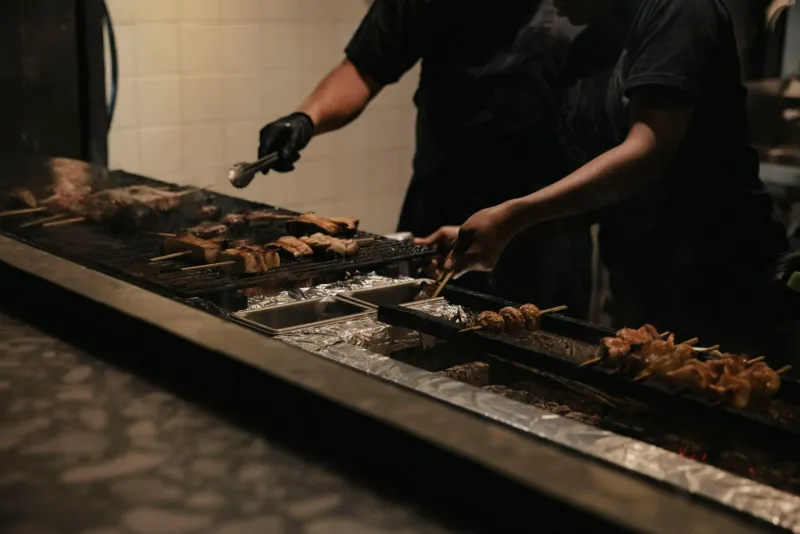
At a celebrated live-fire restaurant in New York's West Village, the kitchen team maps their coal beds every service using infrared thermometers, treating the grill as a landscape of microclimates rather than a uniform heat source. "We talk about the fire the way a farmer talks about a field," the executive chef explains. "There are warm patches, cool patches, places where the smoke behaves differently. Learning to read all of that — and use it intentionally — is what separates a griller from a craftsman."
What Lower Heat Unlocks
The culinary rewards of this approach extend well beyond tenderness. Chefs who have committed to controlled-temperature charcoal work describe a dramatic expansion in the range of ingredients they can cook successfully over live fire. Delicate fish collars, heritage-breed poultry, and even certain vegetables — categories that many kitchens would never risk exposing to a traditional charcoal grill — become viable, even exceptional, when the fire is managed with sufficient care.
Smoke character also transforms at lower temperatures. The phenolic compounds responsible for smoke flavor are absorbed more selectively when the cooking surface is not overwhelmed by radiant heat. The result is smoke that complements rather than dominates — a background note that enhances the ingredient's natural flavor rather than obscuring it beneath a wall of char.
A San Francisco chef known for her ingredient-driven tasting menus describes the shift in terms that are almost philosophical: "At very high heat, the fire is the loudest voice in the room. Every dish tastes primarily of fire. When you bring the temperature down and give it patience, the ingredient finally gets to speak. The fire becomes the accompaniment."
Challenging the Culture of the Sear
This movement runs counter to a deeply embedded cultural narrative in American cooking, where the aggressive sear has long been treated as a near-sacred ritual — the definitive proof that a cook knows what they are doing. That narrative has been amplified by decades of food television, where the visual drama of a flaring grill reads as competence and confidence.
But the chefs at the forefront of precision charcoal work are not interested in theater. They are interested in outcomes. And the outcomes they are producing — meats of extraordinary suppleness, smoke integration that reveals itself in layers across a long finish, and a consistency that high-heat cooking rarely permits — are beginning to shift the conversation in professional kitchens from coast to coast.
The irony, several of these chefs note, is that working at lower temperatures is actually more technically demanding than simply letting a fire burn at maximum intensity. It requires constant attention, a deep familiarity with the fuel, and the kind of patience that cannot be taught in a single season. "Anyone can build a hot fire," observes a Nashville chef whose charcoal-centered menu has drawn national attention. "Knowing when not to is the harder lesson."
A New Definition of Live-Fire Mastery
What is emerging from these kitchens is a redefinition of what excellence over charcoal actually means. It is not measured in the height of the flame or the intensity of the sear. It is measured in the precision of the result — in the way a cut of meat arrives at the table with its internal temperature exactly where it should be, its crust developed without sacrifice, its smoke presence woven into the flavor rather than imposed upon it.
For the American dining public, accustomed to equating fire with force, this represents a genuine recalibration. The finest charcoal cooking, it turns out, is not a spectacle of heat. It is a study in restraint — a discipline that asks the cook to understand the fire well enough to know, above all else, when to let it breathe quietly and do its most careful work.