Dismantling the Lab: How Michelin-Starred Chefs Are Trading Centrifuges for Charcoal
For roughly two decades, the highest echelons of American fine dining were defined by a particular aesthetic: pristine white laboratories masquerading as kitchens, staffed by cooks wielding syringes and thermal immersion circulators, transforming ingredients into architectural statements that resembled food more than they tasted of it. The language was scientific. The philosophy was control. And for a long time, the Michelin Guide rewarded it generously.
That era is not over. But it is, unmistakably, in retreat.
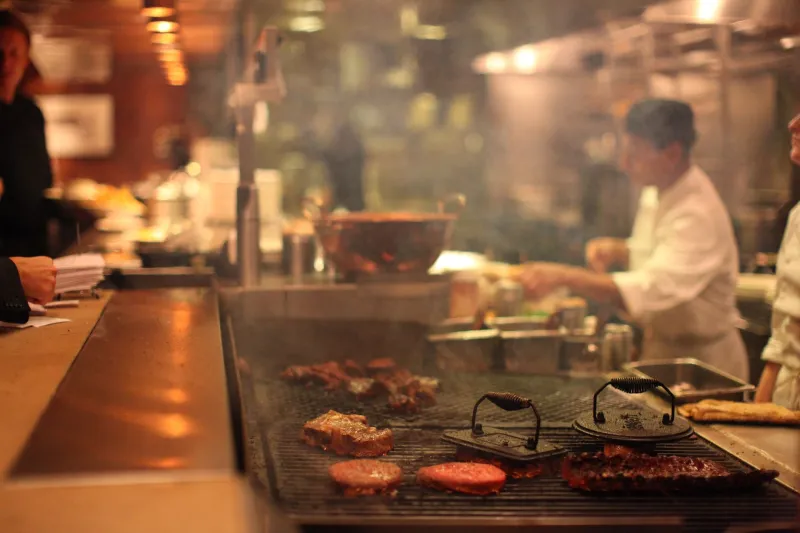
Across the United States, a quiet but consequential movement is reshaping what ambition looks like in a professional kitchen. Chefs who built their reputations on the precision of modernist technique — on methylcellulose gels and liquid nitrogen pearls — are now crouching beside glowing charcoal beds, adjusting airflow with their hands, reading heat through instinct rather than thermometer. The transition is neither nostalgic nor reactionary. It is, these chefs insist, the most demanding culinary challenge they have ever undertaken.
The Limits of Perfect Control
"There is a moment in every modernist kitchen," says Chef Marcus Ellery, whose Chicago restaurant Veld earned two Michelin stars before he stripped its kitchen of nearly every piece of high-tech equipment in 2022, "when you realize that the technology has become the point. You are no longer cooking. You are operating machinery. And the guest can taste the difference."
Ellery's observation cuts to the philosophical core of this movement. Modernist cuisine, at its finest, was genuinely extraordinary — a creative explosion that expanded the vocabulary of flavor, texture, and presentation in ways that remain influential. But its central premise, the elimination of variability through technological intervention, carries an inherent limitation: it distances the cook from the ingredient at precisely the moment when intimacy matters most.
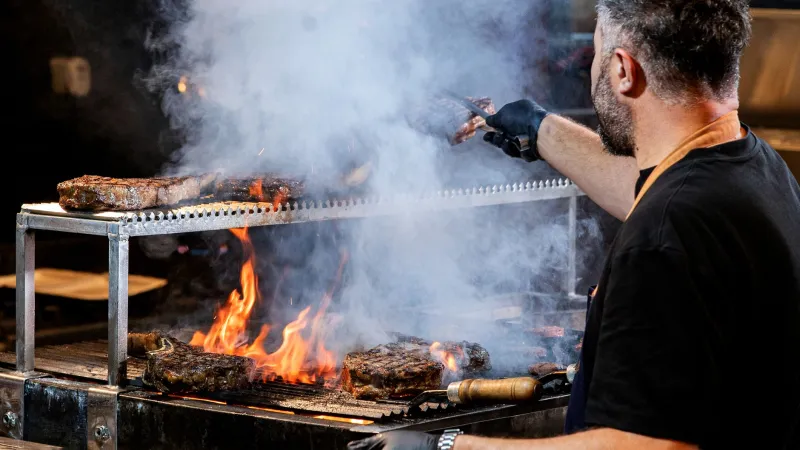
Charcoal cooking inverts that premise entirely. The fire is never the same twice. Humidity, fuel density, airflow, and the particular character of the coals all conspire to create conditions that no algorithm can fully anticipate. A chef working over live fire must negotiate with their medium rather than command it. That negotiation, many argue, is where genuine craft lives.
From Stars to Embers
Chef Renata Solís spent eight years at the helm of a San Francisco tasting-menu institution renowned for its technical precision before opening her current restaurant, Ascua, in 2021. The name is Spanish for ember. The kitchen is built around a single, massive Argentine-style parrilla fueled exclusively by hardwood charcoal.
"People asked me if I was having a breakdown," she says with a measured smile. "They assumed I was simplifying. What I was actually doing was making everything harder."
Solís describes the learning curve as humbling in a way that no modernist technique had been. "With a thermal circulator, you set a temperature and walk away. With charcoal, you are in constant conversation with the fire. You learn to read color, smoke behavior, the sound of fat rendering. You develop a physical intelligence that no cookbook can teach you. That is what I wanted back."
Her menu at Ascua reflects this philosophy with striking elegance. A dry-aged côte de bœuf arrives with a crust developed over a two-zone fire — seared at fierce heat, then rested over cooler embers until the interior reaches a precise, rosy tenderness. A whole turbot, sourced from a Pacific Coast supplier, is cooked directly on the grill grate with nothing but coarse salt and a whisper of oak-forward smoke. The restraint is deliberate, and the results are, by virtually every critical account, more memorable than anything that emerged from her former laboratory kitchen.
Charcoal as a Philosophical Statement
The shift these chefs describe is not merely technical. It carries the weight of a broader cultural argument — one about authenticity, about the relationship between cook and ingredient, and about what fine dining owes its guests.
Modernist cuisine, at its most extreme, occasionally prioritized the demonstration of technique over the communication of flavor. A sphere of olive oil, however technically impressive, does not deepen a diner's understanding of the olive. A charcoal-grilled lamb chop, kissed with smoke and finished with herb-infused fat, tells an entire story about the animal, the land it grazed, and the fire that transformed it.
"Molecular gastronomy asked: what can we do to food?" observes food philosopher and James Beard Award-nominated writer Daniel Pruett, who has tracked this transition closely. "What the charcoal movement asks is: what can we understand about food? Those are fundamentally different questions, and they produce fundamentally different dining experiences."
Chef Aaron Whitfield, whose Nashville restaurant Coalbed opened to significant national attention in 2023, frames it in even starker terms. "I cooked under a modernist mentor for four years. I learned extraordinary things. But I never felt the food. There was always a machine between me and the ingredient. When I started cooking over charcoal, I understood for the first time what it means to actually cook something."
The New Sophistication
It would be a mistake to read this movement as anti-intellectual. The chefs making this transition are among the most technically educated in the country. Their understanding of Maillard reactions, smoke compound chemistry, and heat transfer dynamics is sophisticated precisely because they have studied the science behind what fire does to food. The difference is that they now apply that knowledge through physical practice rather than technological delegation.
What is emerging, in restaurants like Veld, Ascua, and Coalbed, is a new definition of fine dining sophistication — one that measures excellence not by the complexity of the equipment deployed but by the depth of the cook's understanding of fire itself. The charcoal grill, in this context, is not a primitive tool. It is the most demanding instrument in the kitchen.
Michelin, for its part, appears to be paying attention. Several charcoal-forward restaurants have earned or maintained starred status in recent years, suggesting that the Guide's evaluators recognize something genuine in what live fire produces at its best.
The Future Burns Bright
None of this suggests that modernist technique will disappear. The contributions of that era — to our understanding of texture, emulsification, and flavor extraction — are permanent additions to the culinary canon. But the center of gravity in American fine dining is shifting, and the direction it is moving is toward the fire.
For the chefs at the heart of this movement, that shift represents not a retreat but an arrival. After years of building technical competence, they have found something more valuable: a direct, physical, irreducible relationship with the act of cooking itself.
"The fire teaches you things no school can," Chef Solís says, adjusting the airflow on her parrilla with the practiced ease of someone who has spent thousands of hours in conversation with her coals. "It teaches you patience. It teaches you humility. And if you listen carefully enough, it teaches you exactly what the ingredient needs."
In a culinary culture that spent decades celebrating the triumph of technology over nature, that lesson may be the most sophisticated one of all.