Slow the Fire Down: Why Restraint and Precision Are the True Marks of a Charcoal Master
There is a particular kind of theater that plays out at backyard grills across America every summer weekend. Flames leap. Fat drips and ignites. Smoke billows in theatrical curtains. It looks, by every visual measure, like something extraordinary is happening. And yet, in the kitchens of the country's most decorated restaurants, the scene could not be more different. Temperatures hover in carefully managed ranges. Thermometers are consulted with the same reverence a sommelier brings to a rare vintage. The fire, far from raging, glows with a controlled, almost meditative steadiness.
This is the temperature paradox at the heart of serious charcoal cookery: the approach that appears least impressive often produces the most remarkable results.
The Seduction of High Heat — and Its Limits
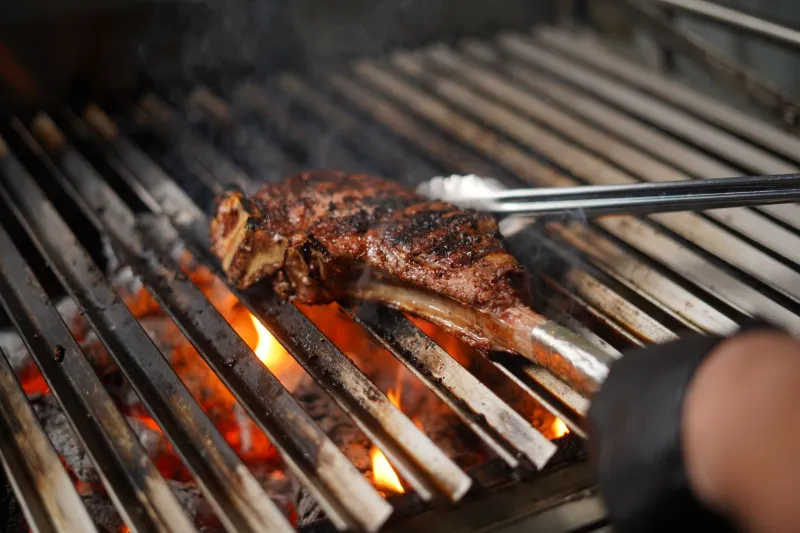
High-heat grilling carries an intuitive appeal. The Maillard reaction — the complex cascade of chemical changes that produces a browned, flavorful crust — does indeed require surface temperatures well above 300°F. For a thin cut of fish or a quickly seared steak, aggressive heat has genuine merit. But the culinary professionals who have spent careers working over charcoal will tell you that this is where many cooks stop learning, mistaking the opening move for the entire game.
"Anyone can build a hot fire," says Chef Marcus Delray, whose wood-fired restaurant in Charleston, South Carolina, has earned consecutive Michelin recognition. "The skill is knowing when not to. When you're working with a heritage pork shoulder or a whole lamb leg, high heat is your enemy. You're creating a hard exterior that locks out the very smoke you're trying to introduce."
The problem with aggressive flames is one of gradient. Extreme surface heat drives moisture out rapidly, contracts muscle fibers, and produces a thick, impermeable bark before interior temperatures have had any opportunity to rise gradually. The result is a product that is simultaneously scorched on the outside and underdeveloped within — texturally compromised and flavored only at its outermost layer.
The Thermal Logic of Low-and-Slow
Charcoal, unlike gas, is a living fuel system. It breathes, evolves, and produces heat in patterns that a skilled cook can learn to read and manipulate. When lump charcoal or quality briquettes are arranged for indirect, lower-temperature cooking — typically in the 225°F to 275°F range — the physics of heat transfer shift in the cook's favor.
At these temperatures, collagen within connective tissue has sufficient time to convert to gelatin, a process that requires sustained exposure to heat rather than a sudden, violent burst of it. Fat renders slowly and bastes the surrounding meat from within. Most critically, smoke — that defining characteristic of charcoal cookery — penetrates the protein at a rate and depth simply impossible to achieve under high-heat conditions.
"Smoke is a flavor ingredient, not a byproduct," explains Chef Yolanda Kim, executive chef at a nationally recognized live-fire restaurant in Nashville. "At high heat, you get surface smoke adhesion at best. At lower temperatures, over three or four hours, smoke compounds actually migrate into the tissue. The flavor becomes architectural — it's built into every layer."
The science supports her. Guaiacol and syringol, two of the primary phenolic compounds responsible for the characteristic smoky flavor profile, are most effectively absorbed by meat when surface moisture is present and temperatures are moderate. High heat rapidly desiccates the surface, closing off this absorption pathway almost immediately.
The Thermometer as Primary Tool
For chefs operating at this level of precision, the thermometer is not a backup instrument — it is the central one. Instant-read probes, leave-in wireless monitors, and even infrared surface thermometers all find a place in the professional charcoal cook's toolkit.
The target is not a single temperature but a relationship between two: the ambient temperature within the cooking environment and the internal temperature of the protein itself. Managing the gap between these two figures — and controlling how quickly that gap closes — is where the craft truly lives.
Chef Delray describes his process for a heritage Berkshire pork shoulder as a study in interval management. "I want my cooking chamber sitting between 240 and 250 degrees. I want the internal temperature of that shoulder climbing no faster than eight to ten degrees per hour through the early stages. If it's moving faster than that, I'm losing moisture and compressing texture. Slow the climb, and you preserve everything that makes that animal worth cooking."
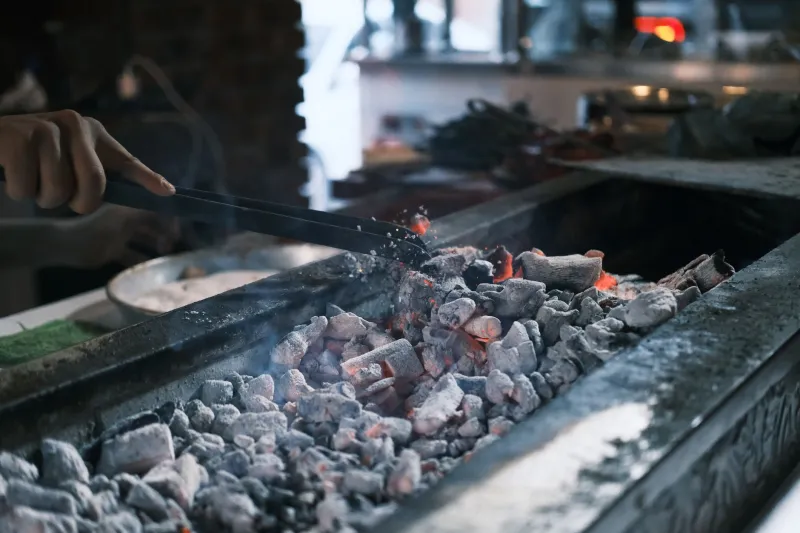
This kind of attention demands that the cook understand charcoal's natural thermal arc — the initial high-heat phase as fresh fuel ignites, the longer plateau of stable radiant heat, and the gradual decline as coals ash over. Skilled practitioners learn to add fuel in calculated increments, manage airflow through vents with precision, and read the color and behavior of coals the way a baker reads the surface of rising dough.
Patience as Professional Discipline
What separates the low-and-slow approach from its high-heat counterpart is not merely technical knowledge — it is a fundamentally different relationship with time. American dining culture has not always rewarded patience. Speed and spectacle have their own commercial logic. But the finest charcoal-driven restaurants have made a different argument: that guests who understand what they are eating will wait for it, and that the wait itself becomes part of the experience.
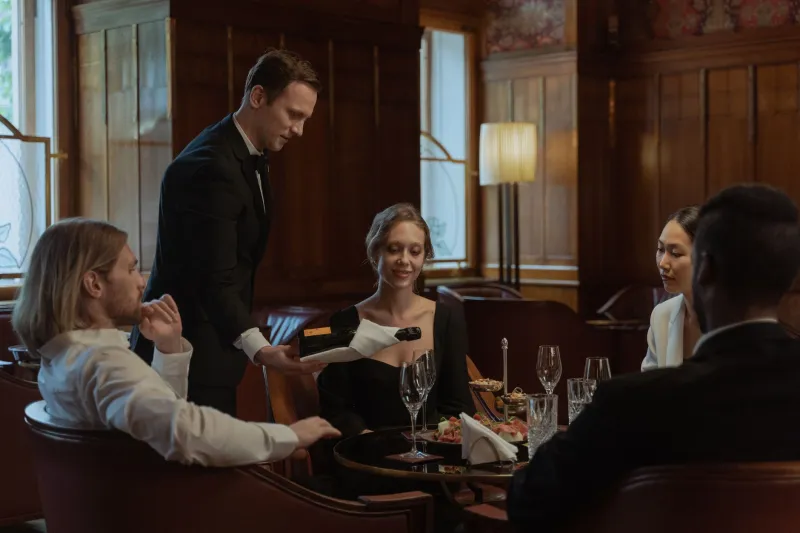
At several acclaimed establishments in cities including Austin, New York, and Los Angeles, tasting menus built around low-temperature charcoal preparations have become signature offerings. Courses arrive not because a timer has expired, but because a thermometer has confirmed readiness. The kitchen operates on the fire's schedule, not the other way around.
"There's a humility required," says Chef Kim. "You submit to the process. You don't rush it. And when the guest tastes what comes out of that — the tenderness, the smoke integration, the depth — they understand immediately why it couldn't have been done any other way."
Practical Lessons for the Home Cook
The principles that govern professional low-and-slow charcoal cooking are not exclusive to restaurant kitchens. Home cooks willing to invest in a reliable dual-probe thermometer, quality lump charcoal, and the discipline to resist the urge to open the lid every ten minutes can access the same dynamics.
Begin by establishing a stable two-zone fire: coals banked to one side, the cooking grate on the opposite side entirely clear of direct heat. Allow temperatures to stabilize before introducing the protein. Resist the impulse to chase high surface temperatures on cuts that benefit from time — pork ribs, beef brisket, whole chickens, and leg of lamb all reward the indirect, lower-heat approach far more generously than they reward aggression.
Most importantly, trust the thermometer over the clock. Recipes that prescribe fixed cooking times are, at best, approximations. The fire, the fuel, the ambient outdoor temperature, and the specific cut of meat all introduce variables that only a thermometer can honestly account for.
The Quiet Confidence of Controlled Fire
The finest charcoal cooking does not announce itself with drama. It arrives at the table in the form of a crust that yields to gentle pressure, a smoke ring that speaks to hours of careful management, and a depth of flavor that no high-heat shortcut can replicate. It is the product of a cook who has learned, perhaps counterintuitively, that the most powerful thing one can do with fire is learn when to let it breathe slowly.
In that restraint lies the true craft of charcoal cuisine — and it is far more difficult to master than simply turning up the heat.