Smoke in the Glass: How Charcoal Menus Are Forcing America's Top Steakhouse Sommeliers to Reinvent the Bottle List
For generations, the American steakhouse sommelier operated within a comfortable framework. A bone-in ribeye demanded a bold Cabernet Sauvignon. A dry-aged strip called for something from Napa's hillside estates. The logic was clean, the pairings were predictable, and the wine lists at the country's most celebrated chophouses reflected an almost liturgical consistency.
That certainty is dissolving — and charcoal is the reason.
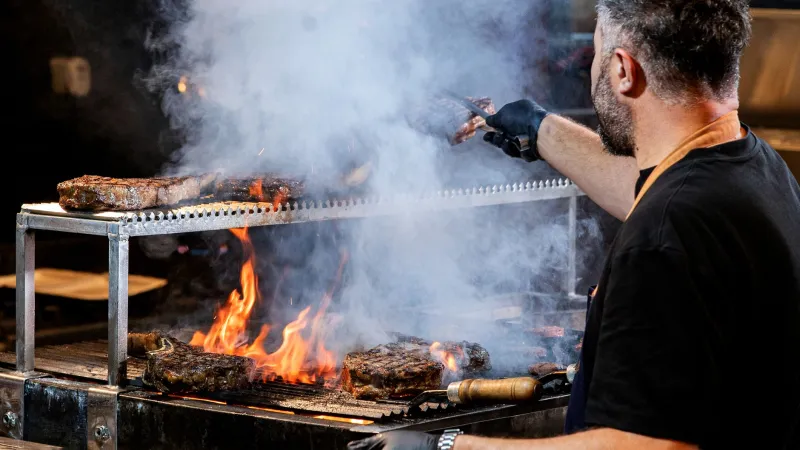
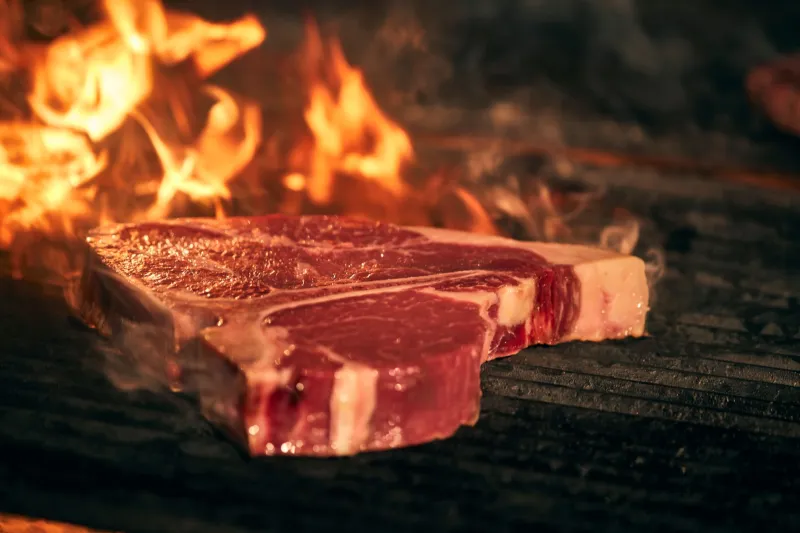
As America's finest steakhouses commit more fully to live-fire, charcoal-centered cooking, the flavor profile of even a familiar cut of beef has shifted in ways that make traditional pairing assumptions feel, at best, incomplete. The smoke layered into a prime tomahawk over hardwood lump charcoal, the bitter char edge on a seared bone marrow preparation, the mineral depth that a long ember rest imparts to dry-aged beef — these are flavors that a textbook Cabernet pairing was never designed to address.
"What charcoal does to food is fundamentally additive," explains Marcus Tilley, head sommelier at a nationally recognized steakhouse group with locations in Chicago and New York. "It doesn't just apply heat. It introduces an entirely new flavor dimension — smoke compounds, phenolic bitterness, a kind of savory darkness — and that changes what the wine needs to accomplish at the table."
The Problem with the Classic Playbook
The traditional steakhouse wine list was built around fat and protein. High-tannin reds from Bordeaux, Napa, and Tuscany were selected for their ability to cut through richness and amplify the savory depth of well-marbled beef. It was a formula that worked beautifully — for beef cooked on gas or broiled under radiant heat.
Charcoal changes the equation. Where a gas-broiled steak presents a relatively clean canvas of fat and umami, a charcoal-grilled cut arrives at the table carrying smoke aromatics, carbonized crust compounds, and what many sommeliers now describe as a "mineral smokiness" that behaves almost like a third ingredient in the pairing.
High-tannin wines, several sommeliers note, can amplify that bitterness in ways that feel harsh rather than harmonious. "I had a guest order a very young, very tannic Napa Cab with our charcoal-grilled prime rib one evening," recalls Elena Vasquez, wine director at a celebrated Dallas steakhouse. "The combination wasn't unpleasant, but it was relentless — all edge, no resolution. The smoke and the tannin just kept fighting each other."
That experience prompted Vasquez to spend the better part of a year systematically retasting her cellar with charcoal-grilled dishes as the reference point. What she found surprised her.
Unexpected Discoveries: The Wines That Work
The emerging consensus among sommeliers who have undertaken this kind of structured re-evaluation points toward wines with specific characteristics: moderate tannin with high integration, pronounced fruit that can hold its own against smoke without being overwhelmed, and — perhaps counterintuitively — a degree of earthiness that mirrors rather than fights the char.
Northern Rhône Syrah has emerged as something of a revelation in this context. The variety's natural affinity for smoked meat is well-documented, but sommeliers working with charcoal-focused menus report that the specific combination of olive tapenade character, cracked black pepper, and controlled tannin structure makes it exceptionally versatile across a range of charcoal preparations — from lightly kissed seafood to intensely charred prime cuts.
"Crozes-Hermitage has become one of the most useful bottles I have," says Tilley. "It has enough structure to stand up to a serious piece of beef, but the tannins are polished enough that they don't clash with the smoke. And there's a savory, almost mineral quality in a good Crozes that seems to echo what the charcoal is doing to the food."
Domestic options are also drawing renewed attention. Oregon Pinot Noir, long considered too delicate for steakhouse service, is finding a new audience when paired with charcoal-grilled preparations where the fire provides the weight the wine lacks. "A good Willamette Valley Pinot with our charcoal-roasted duck breast is one of the most elegant pairings we offer," notes Vasquez. "The smoke fills in where the wine is light, and the wine's acidity cuts through the fat in a way that feels effortless."
Perhaps the most surprising trend is the growing presence of aged Spanish Garnacha on steakhouse lists — a category that barely registered in these rooms a decade ago. Its combination of dried fruit depth, earthy rusticity, and low-to-moderate tannin has proven to be an unusually forgiving match for the full spectrum of charcoal cookery.
Rethinking the By-the-Glass Program
The implications of charcoal's rise extend beyond the cellar list to the by-the-glass program, where the challenge of pairing becomes more acute. Guests ordering from a charcoal-focused menu may move through multiple preparations in a single sitting — a delicately charred scallop appetizer, a lightly smoked vegetable course, a heavily charred prime cut — and a single glass selection is expected to navigate all of it.
Several sommeliers have responded by introducing what they describe as "fire-forward" by-the-glass selections: wines chosen specifically for their ability to complement the full arc of a charcoal-driven meal rather than a single dish. These tend to be medium-bodied reds with generous fruit and restrained tannin, or structured whites with enough weight to hold up to smoke without being dominated by it.
"I've started thinking about the by-the-glass list almost like a flight designed around fire," says Vasquez. "Every bottle on that list has been tested against our actual charcoal preparations. If it doesn't work with what's coming out of the kitchen, it doesn't belong on the list."
The Larger Shift in Sommelier Identity
What is perhaps most significant about this moment is not the specific bottles that are rising or falling in favor, but the degree to which charcoal cookery is reshaping the sommelier's professional orientation. In the most charcoal-committed dining rooms, wine directors are spending time at the grill, studying how different fuel compositions and cooking temperatures affect flavor output, and working in direct collaboration with the culinary team in ways that were rare in traditional steakhouse culture.
"I now understand what the kitchen is doing with fire in a way I never did before," says Tilley. "And that understanding changes how I approach every single bottle decision. Charcoal isn't just a cooking method — it's a flavor system. And if you're going to pair wine with it seriously, you have to understand the system."
The wine list at a great American steakhouse has always been a statement of intent — a declaration of what the house believes food and drink can accomplish together. In the age of charcoal, that statement is being rewritten from the ground up, one unexpected bottle at a time.